


What Makes a Beautiful Tone on the Piano?
- 2 days ago
- 3 min read
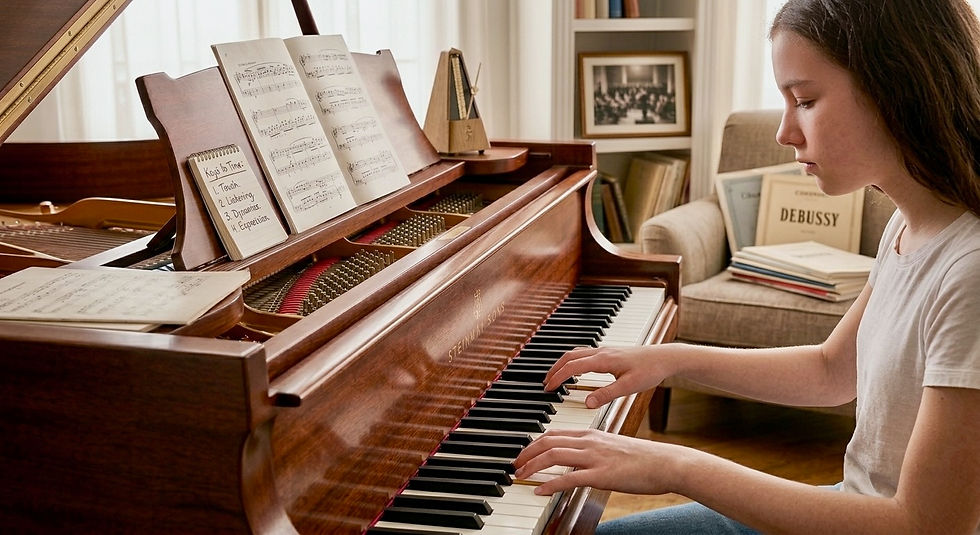
A beautiful piano tone is something everyone can recognize, even without musical training. It’s the difference between notes that simply “happen” and notes that truly sing. While the piano is often described as a percussion instrument, since hammers strike the strings, the artistry of tone comes from how the player shapes that moment of contact.
Here are the key elements that create a beautiful tone on the piano:
The Quality of Touch
Tone begins before the sound is even produced. It lives in the way the finger meets the key.
A harsh, shallow touch can create a brittle sound, while a deep, supported touch produces a richer, warmer tone. Think of pressing into the key with intention rather than tapping from above. The goal is not force, but connection, as if your finger is gently “holding” the key all the way to the bottom.
For students, a helpful image is this: Imagine sinking into soft clay rather than pecking at a hard surface.
Weight vs. Force
One of the most common misunderstandings is that louder playing requires more force. In reality, a beautiful tone comes from weight, not tension.
When the arm is relaxed and supported, its natural weight transfers into the keys, producing a full, resonant sound. When the hand is tight or forced, the tone becomes thin and harsh.
I encourage my students to feel:
A loose shoulder
A flexible wrist
Fingers supported, but not stiff
A beautiful tone should feel almost effortless.
Listening: The Most Important Skill
A pianist creates tone not just with their hands, but with their ears.
Students often focus so much on “playing the right notes” that they forget to listen. But a beautiful tone grows from awareness:
Is the melody singing above the accompaniment?
Is the sound too sharp or too dull?
Does the phrase feel connected?
When students truly listen, they begin to adjust naturally.
A simple habit to try: Play one note and describe the sound. Is it warm? Bright? Heavy? Singing?
This builds sensitivity over time.
Control of Dynamics and Balance
Beautiful tone is not just about individual notes; it’s about relationships between sounds.
For example:
A melody should float above a softer accompaniment
Chords should be balanced, not dominated by one note
Soft playing should still have depth, not weakness
Tone becomes beautiful when everything has its place and purpose.
Phrasing: Making the Piano Sing
A beautiful tone is shaped over time, not just in a single note.
Just like a singer shapes a phrase with breath, a pianist shapes a musical line with direction:
Where is the phrase going?
Where does it rise and fall?
Where does it relax?
Without phrasing, even a good sound feels mechanical. With phrasing, the music feels alive.
Pedaling and Resonance
The pedal adds color, depth, and connection between sounds—but it must be used carefully.
Too much pedal can blur the tone. Too little can make it dry.
A beautiful tone often comes from:
Clean pedal changes
Listening to how harmonies blend
Using the pedal to enhance, not cover
Emotional Intention
Ultimately, tone reflects the player’s inner imagination.
Two students can play the same note, yet produce completely different sounds because one is simply pressing a key, while the other is expressing an idea.
I encourage my students to ask:
What mood am I trying to create?
What color should this sound have?
Is this gentle, joyful, longing, or bold?
When there is intention, the tone becomes meaningful.
Final Thought
A beautiful piano tone is not a single technique; it is a combination of touch, listening, control, and imagination. It develops slowly, through awareness and care.
For young students, especially, the journey begins with one simple idea:
Don’t just play the note, listen to it, shape it, and care about how it sounds.
That is where true beauty begins.
Comments